
Matthew Rothenberg Select Projects

Postcards from Null Island 2016

Null Island is a place lost in-between the invisible boundaries of computer code.

The distinction between zero (the value of absolute nothing) and null (the absence of value itself) is a subtle concept for humans. For computers, this distinction is quite important, yet fraught with even more difficulty and peril—leading to an entire category of software bugs.

As a result of this phenomena, most large databases of geotagged photos contain a cluster of “lost” user data at latitude-longitude coordinates 0.0°, 0.0° – discoverable if plotted on a map a few hundred of miles off-shore in the Gulf of Guinea. Unbeknownst to the users of their systems, the periodic and rare occurrence of this bug may relocate their uploads there. Engineers working on GIS systems aware of this phenomena have affectionately termed this location “Null Island.”

For years I have been enamored with the notion of these lost photos, of people’s unknowing and accidental travels binding them together to this unreal yet physical space, and in making visible the hidden connections.

What sort of place is Null Island? Who has visited there, and what experiences have (unknowingly) bound them together?

Postcards From Null Island is autonomous and unmonitored software that continuously trawls Flickr and Instagram, looking for any new photos that have been uploaded from Null Island. Whenever they are located, a physical postcard is printed and mailed to me, so that I periodically receive mementos from people’s unknown and undiscovered travels to this mythical land.

For one year, these postcards arrived, and slowly began to tell a story.
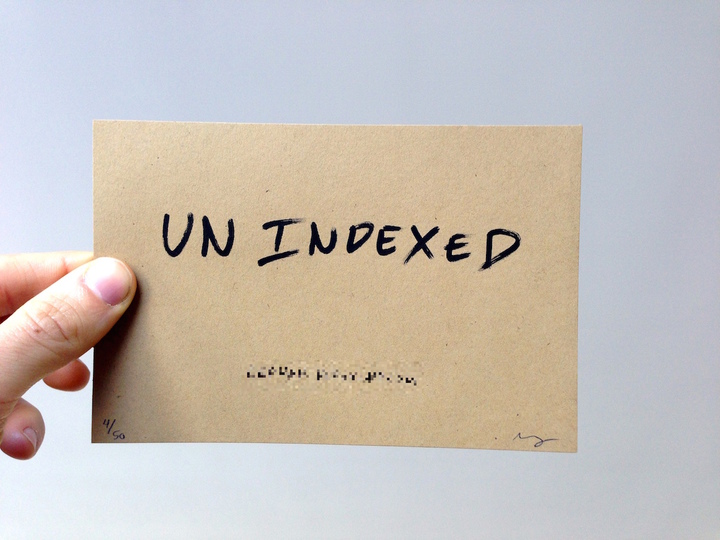
Unindexed 2015

An experiment in the nature of ephemerality and persistence on the web.

Unindexed was a website that continuously searched Google for itself over and over. The moment it found itself in the search results it would irrevocably and securely delete itself, making the precise instant of algorithmic discovery the catalyst of destruction.

Visitors were encouraged to post contributions to the site (which would also be destroyed when the site was detected). They were then invited to share the site with others, bearing in mind the impact their method of sharing would have on hastening the eventual discovery of the URL by Google search bots.

A tension was created between the desire to share and the desire to keep it to oneself, and the site spread on a small scale via postal mail, word-of-mouth, etc.

The site was discovered by Google after 22 days on Tue Feb 24 2015 21:01:14 GMT+0000 (UTC) and consequently instantaneously self-destructed milliseconds later. Prior to the automatic deletion it received hundreds of visitors and dozens of contributions. No backups were kept.

Posthumously featured in VICE, Boing Boing, PC World, & “The New Aesthetic and Art: Constellations of the Postdigital” (Contreras-Koterbay/Mirocha, 2016).

Emojitracker 2013

Emojitracker is an experiment in realtime visualization of Twitter data.

Emoji, colorful symbols on mobile phones that are used for text messaging, first emerged in Japan but have since grown to explosive global popularity. Emojitracker utilizes realtime stream processing technology I developed in order to visualize the full volume of emoji usage on Twitter in realtime. All 865 emoji symbols are presented in a grid, which instantaneously lights up when a symbol is used in a tweet, presenting hundreds of interactions per second. The overall effect is to present both the overwhelming volume of symbolic communication occurring, and make visible the patterns in how we use this new form of communication.

Launched in July 2013, it has since analyzed over 25 billion tweets.

I adapted Emojitracker into a physical interactive installation which was featured at Eyebeam Art and Technology Center in January 2014. The projected installation encouraged interaction, and visitors commonly pulled out their smartphones in order to influence the display, or engaged in debate about the relative popularity and meaning of different symbols.

Emojitracker has been written about by The New Yorker, New York Times, Wall Street Journal, Washington Post, Chicago Tribune, Spiegel, Le Monde, Wired, Slate, Vice, Hyperallergic, Details Magazine, Complex, The Verge, Gizmodo, Buzzfeed, and many others. Subsequently exhibited at Museo Nazionale del Cinema (Torino, Italy), 2019.